Learning to mitigate the effects of landslides in Bhutan
Posted: 9 March 2026
Rinzin Wangmo from Bhutan is studying a Master of Engineering Science at Flinders University in South Australia, with the support of an Australia Awards Scholarship.
In the following video recorded in her first months in Australia, Rinzin discusses her experiences as an Australia Awards scholar.
At home in Bhutan, Rinzin works as a geologist. In this role, she says, “I basically deal with landslide studies. Bhutan is a mountainous country, so we have geohazards, specifically landslides and earthquakes.” She continues, “Due to landslides, we have a lot of infrastructure damages which incur economical losses.”
Seeing the knowledge gaps in this field firsthand led Rinzin to apply for an Australia Awards Scholarship, with the goal of learning how to help Bhutan more effectively mitigate the impact of landslides. “I want to be one of those experts helping my country,” she says.
Now she’s at Flinders University, taking her first steps on that path. “I’m doing a combination of civil engineering and environmental engineering,” she says. “My studies in Australia will equip me with the skills and knowledge that I need.” After she completes her degree, Rinzin will return to her job in Bhutan. “I’m on my study leave,” she points out. “So when I go back, I will implement this knowledge and see how it helps. this will be good for the country.”
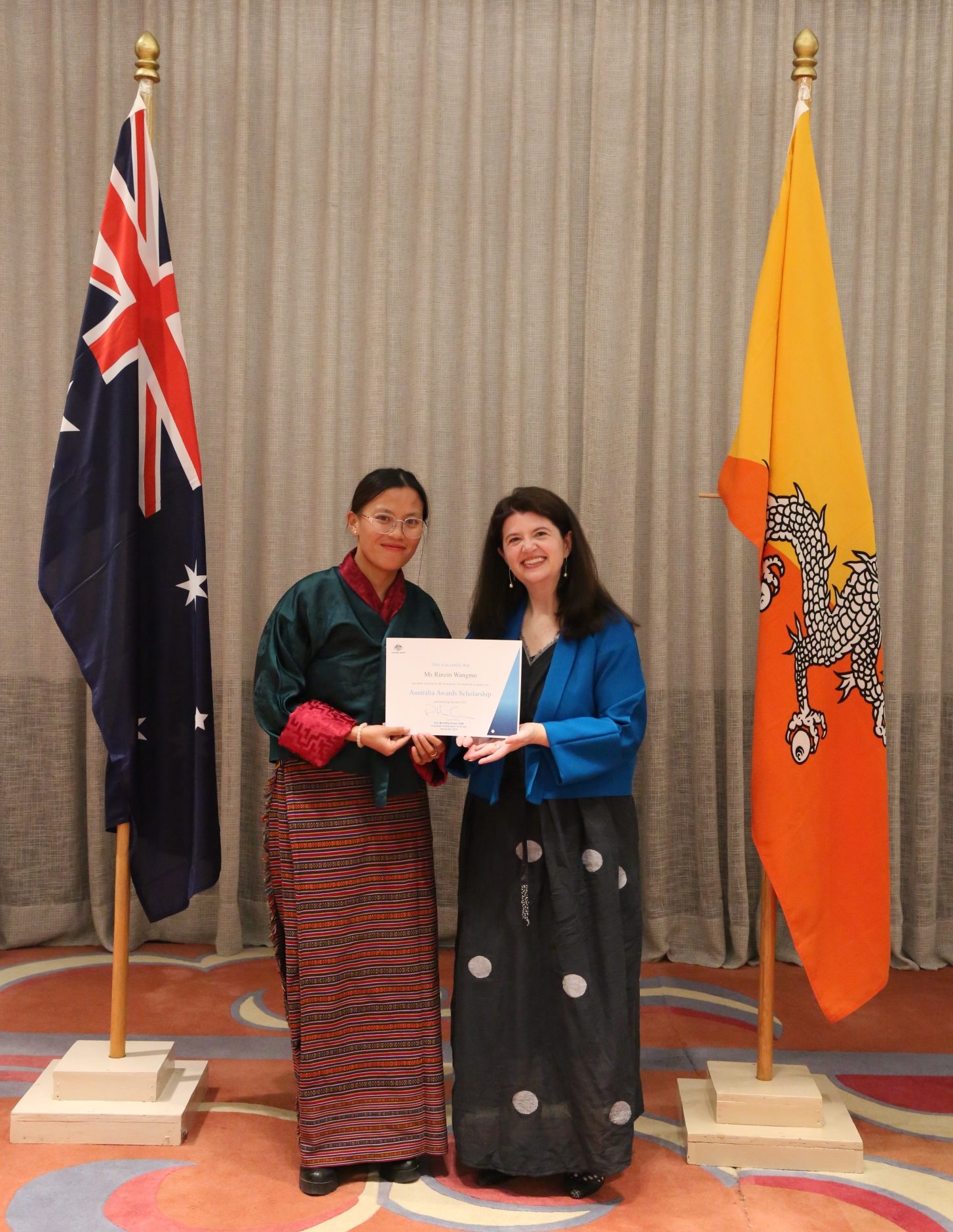
Rinzin (right) receiving her Australia Awards Scholarship certificate from Minister-Counsellor, Carly Partridge (right) from the Australian High Commission in New Delhi.
Acknowledging that it was still her first semester in Australia, she says, “I think it would be quite early to say I learnt a lot,” but nevertheless gives an impressive number of examples of what she has gained. “One thing I learnt is how to write good reports … how to start the introduction and how to put my arguments and how to conclude.” She goes on, “Apart from gaining knowledge and skills and learning about time management, I also learnt to be open minded—because I’m meeting new people, and I get to experience new culture.”
She looks forward to learning more about geographic information system (GIS) modelling in her next semester. GIS uses remote sensing to create 3D models that allow users to better understand geographic data. “I want to learn more about modelling—specifically, the landslides,” she says. “I think it’s very relevant to our country because we don’t have many GIS experts … I want to really model those landslides so that I can understand what’s really happening.”
Most of all, Rinzin is enamoured of the style of education she has encountered in Australia. “It’s so cool,” she says. “The teaching style in Australia is quite engaging and creative, which is quite different from what I used to do back in my country, which is focused more on memorisation. So the teaching style is enjoyable, and I learnt a lot through this teaching style.”
This is not Rinzin’s first experience of studying abroad: she completed her undergraduate degree in India. However, she has been out of the university environment for the past six years, and has found readjusting to being a student challenging. But the academic staff at the university have been there for her every step of the way. “They have been so good to me,” Rinzin says. The staff explain what the requirements are and what she needs to do—and if she has any doubts, they clarify the issue. “They just motivate me to do it better. I’m so thankful,” she says.
The university staff have not been her only source of support. “The Australia Awards team in Bhutan has helped me a lot, especially in the session called Pre-Departure Briefing, where they brief us [on] what to expect,” she says. “They give us all the information about what to do, what not to do. It’s very important.” Nor did the support end with the team in her home country. “When I came here, the Australia Awards team here also helped me a lot. They helped me in settling [in], helped me in my academic issues … basically, they help you in every area they can.”
Overall, she says, “Studying in Australia has been fun. it’s exciting, and it’s quite interactive.” Despite some stressful moments early on, she says, “In general, everything’s good. I love the atmosphere.”
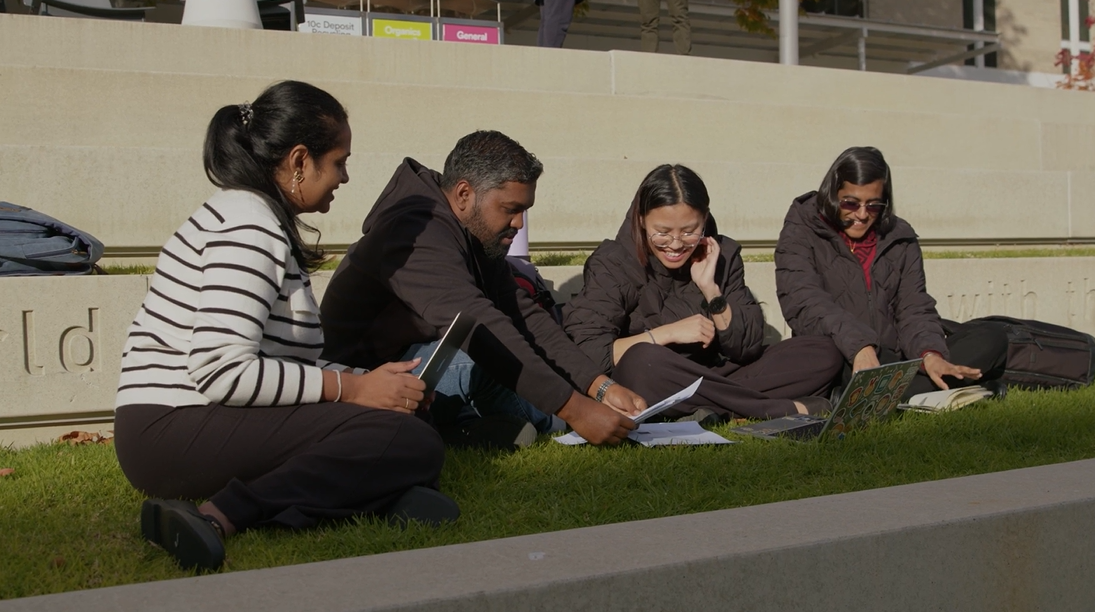
Rinzin (second from right) pictured interacting and studying with other Australia Awards scholars from South Asia.
It’s still early days for Rinzin to have seen much of Australia, but she has taken some chances to explore locally. “I’ve been to Adelaide Hills; Hahndorf, the German village; and some of the beaches,” she says. “I’m more of a mountain person, so I like the Adelaide Hills and Hahndorf. And they’re so beautiful. They’re scenic. The air is fresh, and it’s just like the scene out of a movie.”
Despite “falling in love with everything” in the hills, Rinzin also hopes to visit central Australia. “I want to go to Uluru,” she says—noting that, as a Buddhist, she recognises the spiritual importance of the place. “I just want to go there and see how beautiful it is.”
Alongside Australia’s unique landscapes, the country’s people have also made an impression on Rinzin. “Everyone’s friendly, and I get to meet new people. I learn about their culture and how they find their life in Australia, and it’s amazing listening to their stories,” she says. “I love it.”
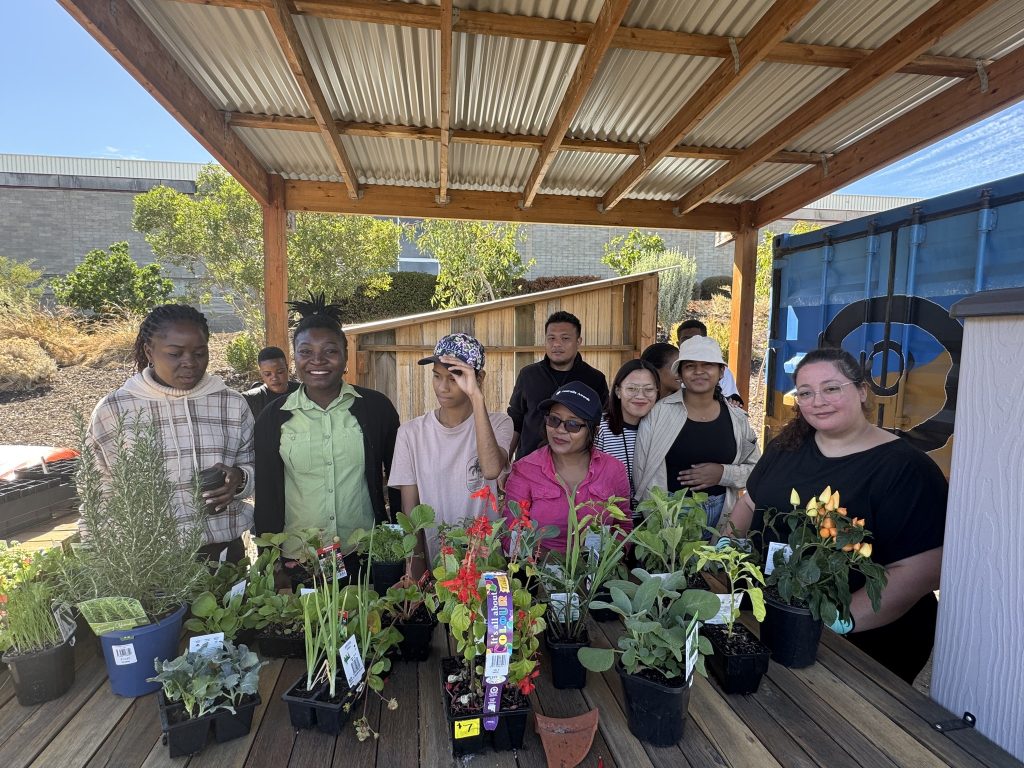
Rinzin (third from right in black and white striped top) and other Australia Awards scholars visit the Flinders University community garden during the Introductory Academic Program.
Rinzin is unequivocal when asked about her advice for people in Bhutan who are considering applying for an Australia Awards Scholarship. “Apply,” she says. “I’m not being biased, but it’s one of the best scholarships.” She highlights that the Scholarship includes both a good stipend and good education. “With good education, you have [a] good future,” she notes. “So just apply.”